
Before You Apply: 6 Things to Check in a Remote Job Listing
 Claude
 Perplexity
A job ad says "remote".
You apply, get to the second interview, and learn it means three days in an office in Subang Jaya. Or "hybrid" turns out to be one office day a month. Or "WFH" means a six-month trial with a return-to-office date already written somewhere.
The types of work in job ads are not standardized.
Employers in Malaysia, Singapore, and Indonesia use them loosely, and job boards may not fully understand them. Ten minutes of checking before you apply saves you two rounds of interviews for a job that's not for you.
This guide gives you six things to check and shows them on three real listings.
It also tells you which answers you should get from the job ad and the questions you should ask at screening. Before moving on to the questions, you need to have a clear understanding of what remote, hybrid, and WFH mean.
The three work types you should know.
Fully remote means no regular office attendance. You may still be asked to attend onboarding, an offsite inspection, or a client visit. You will almost always be asked to live in a specific country or region the employer expects.
Hybrid means a fixed split between home and an office, often two or three days a week. You need to live within commuting distance of that office. According to the Ministry of Manpower, 72.7% of companies in Singapore offered at least one scheduled flexible work arrangement in 2024, up from 68.1% in 2023.
Work From Home (WFH) refers to where you actually work, not the arrangement. Some employers mean fully remote; some mean hybrid; some mean a temporary setup. In the Indonesian context, the job listing is often paired with "WFO" (work from office) to describe the work schedule. The only way to find what the term means for the specific employer is to ask.
The Six Things to Check
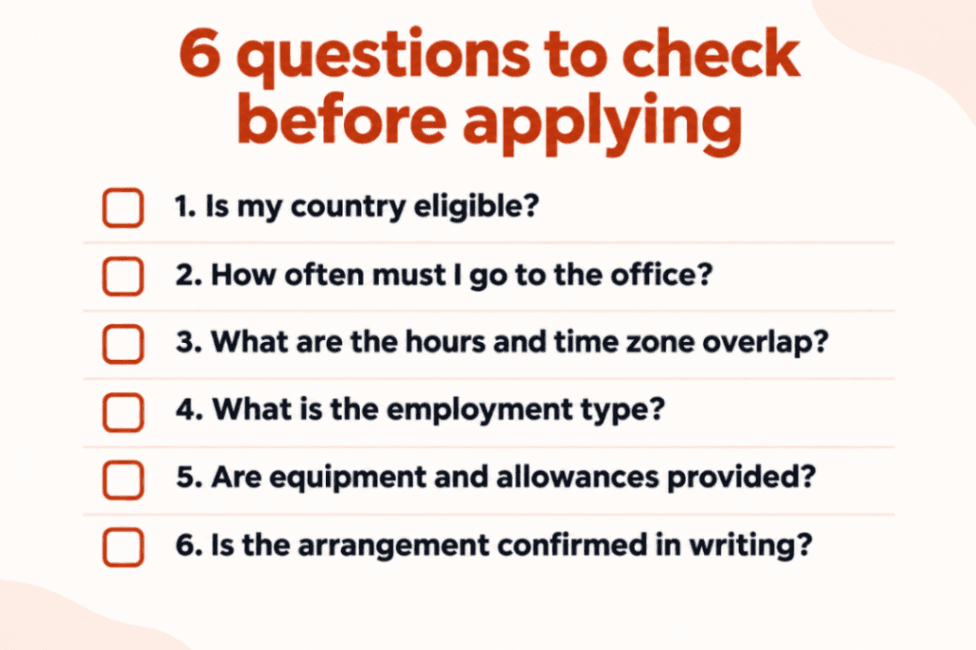
Which countries can I work from?
Most remote roles require you to be a resident of your country of choice because the employer's payroll and legal setup applies only to that country. "Remote APAC" and "Remote Worldwide" do not tell you whether Indonesia or Malaysia is included. If you're not sure, ask.
How many office days are there, and where is the office?
For hybrid, you need the number of office days and the office location. For remote, you need to know about the onboarding, offsites, and client travel, and who pays for them.
What hours and how much time zone overlap?
Get the exact hours in your local time. Four hours of mandatory overlap with Berlin time limits flexibility in your work and may not suit your local time. A US West Coast team's 9 am is midnight in Kuala Lumpur and Singapore during their daylight saving time. And 1 am during standard time.
Employee, employee through an employer of record (EOR), or contractor?
This is important for you to decide the statutory contributions, your leave, and any medical cover. This means EPF, SOCSO, PCB and EIS in Malaysia; CPF in Singapore for citizens and permanent residents; BPJS in Indonesia. The same work type on job listings can mean three different pay packages.
What equipment and allowances are provided?
Laptop, monitor, internet or electricity allowance, and coworking budget. "Benefits package" in an offer letter can mean a laptop and nothing more. Make sure you have everything you need to perform the job, including the tools and applications.
Is the arrangement written down, and is there a return-to-office (RTO) plan?
Ask whether remote and hybrid work setups are mentioned in the contract or in a policy, or if it's just a hiring manager's say-so. Ask whether anything is planned to change in the next twelve months. Arrangements can change; written terms will enlighten you.
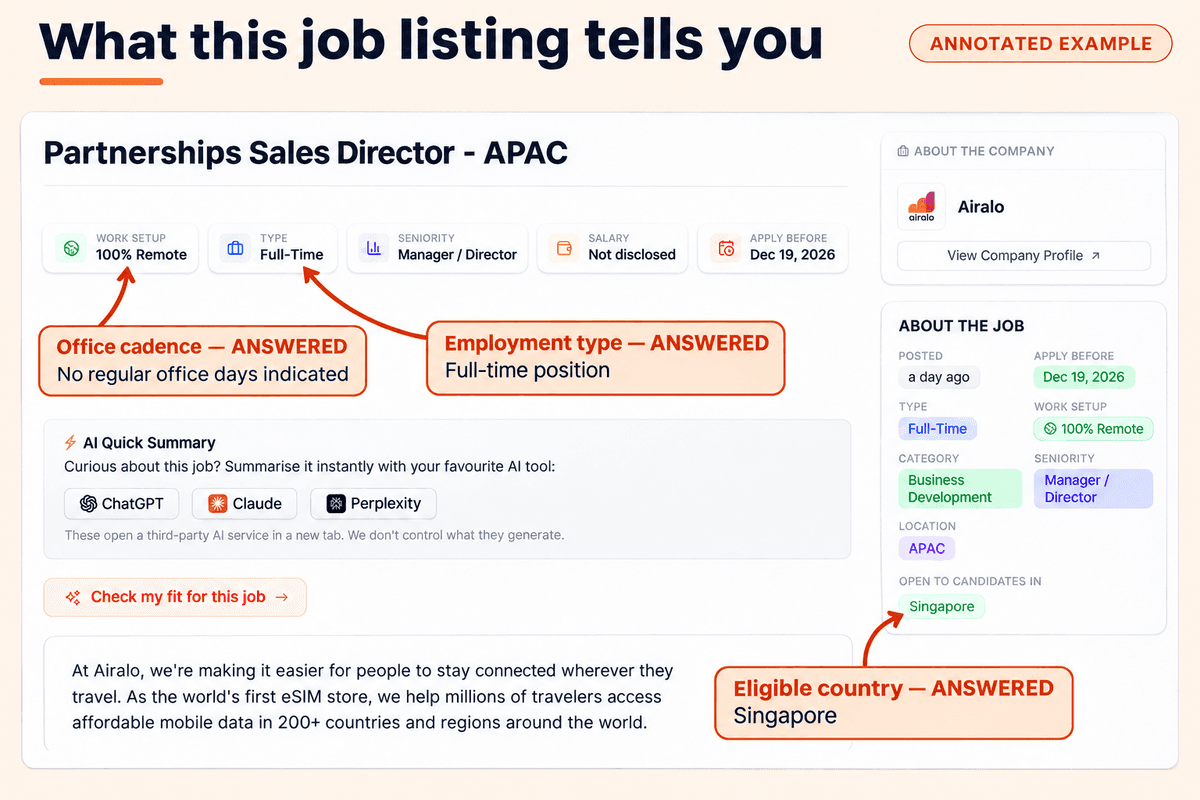
Check on real listings in Kerja Remote.
These three are live on Kerja Remote on 19th of November 2026. Each shows what the job listing answered, what it left open, and what to ask. They are examples of how to read a listing, not an assessment of the employer.
Job Listing 1: Optro, Head of APAC Marketing (100% Remote Full-Time job in APAC)
- What this job listing answered: Fully remote, full-time, no office days, a regional eligibility
- What is left open: Which countries inside APAC the company can hire in. Hours and overlap for a role spanning the region.
- What to ask: Which countries within APAC you're employing from and through what entity? What hours overlap, and are there any specific times the job requires us to be available?
Job Listing 2: Twilio, Senior Global Campaign Strategist (100% Remote, Full-Time Job in Singapore)
- What this job listing answered: Fully remote, no office days, you must be based in Singapore. A company's presence in Singapore implies full-time employment.
- What is left open: Overlaps with a "Global" campaigns team, likely US or European; any travel to regional offices.
- What to ask: Which time zones does the campaign team work across, and what overlap is expected from Singapore?
Job Listing 3: Michael Page (recruiter), Data Analytics Senior Analysts (100% Remote, Full-Time Job in Singapore)
- What this job listing answered: Fully remote, no office days, you must be based in Singapore. A company's presence in Singapore implies full-time employment.
- What is left open: Overlaps with a "Global" campaigns team, likely US or European; any travel to regional offices.
- What to ask: Which time zones does the campaign team work across, and what overlap is expected from Singapore?
Where to find each answer
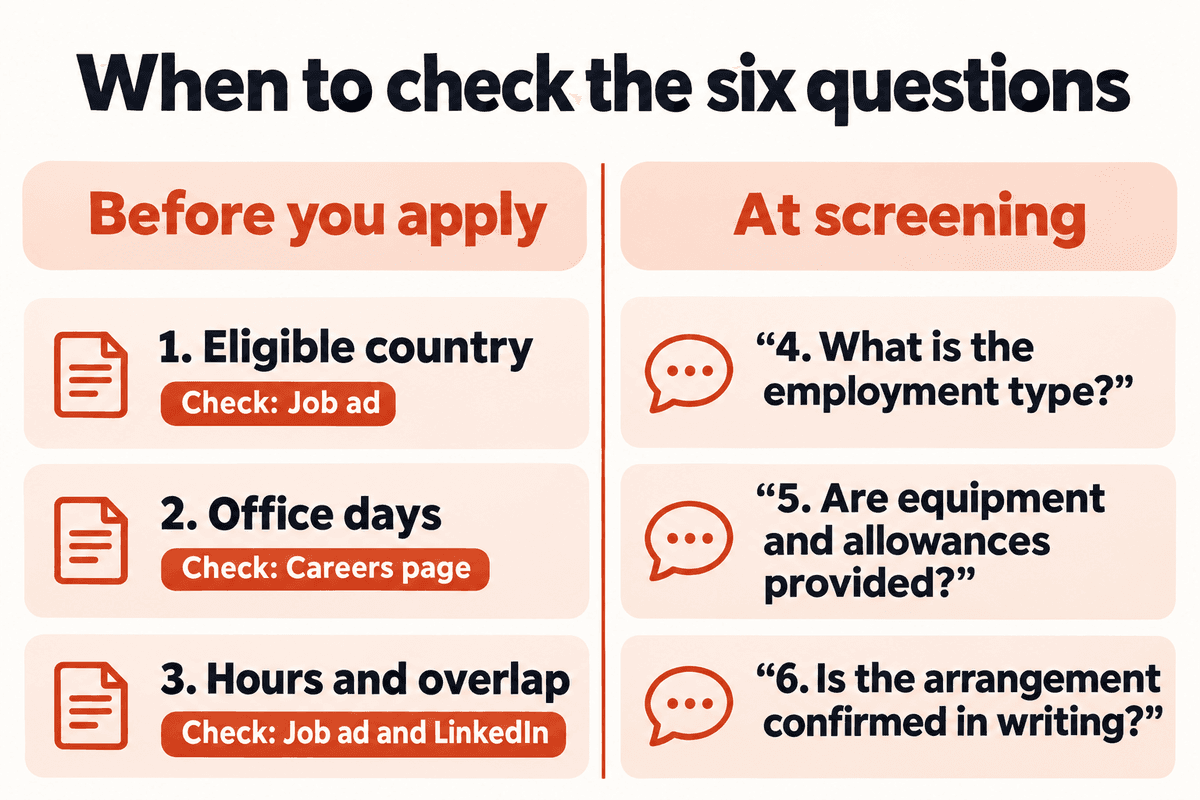
Split the six questions into what you check before applying and what you ask at screening.
Before you apply, from the job listings and the employer's career or job pages:
- Country: The location field, and whether a travel or any offsite meeting is required with clients. Sometimes, even if you're based in Malaysia, you may be asked to travel to the APAC region, such as Indonesia, the Philippines, or even Vietnam.
- Office cadence: The description, the careers page, and the company office locations. If the hiring manager and the team are all in one city when you check the company's LinkedIn page, that's a big reason for you to ask about the location requirements. Sometimes you just have to ask if you're confused
- Employment type: Terms like "contract", "contractor" or "freelance" anywhere in the job description, and also check whether the employer has an entity in your country. Usually, if they don't have a registered entity, it will be either EOR or Contractor.
At screening, clarify everything:
- What are the working hours? Is there any overlap? Should I be available for US or European time?
- What equipment and allowances come with this role?
- Is it a remote or hybrid arrangement? Any plan to change the working setup in the next 12 months?
Write all the answers down next to each application. When an offer comes, compare them with each other. Don't do guesswork here. You're not sure about something about the job, just ask.
What if you want flexibility from your current employer
Malaysia and Singapore offer a formal route to ask.
Indonesia does not, yet. None of the three gives a right to a remote job automatically.
- Malaysia (Peninsular Malaysia and Labuan): Under sections 60P and 60Q of the Employment Act 1955, an employee can request in writing to vary hours, days or place of work. The employer needs to reply in writing within 60 days (2 months) and state the grounds for refusal. Sabah and Sarawak have separate ordinances for their requests.
- Singapore: The Tripartite Guidelines on Flexible Work Arrangement Requests have been in force since 1 December 2024. Employers must have a process for formal requests and respond within two months, according to the Ministry of Manpower. They may refuse on reasonable business grounds.
- Indonesia: No official remote-work provision in the Manpower Law. The Minister of Manpower's March 2026 circular encourages companies to offer one work-from-home day a week, according to Kemnaker. It's just an appeal, not a rule.
For a new job, these rules do not apply until you are employed.
Get the work arrangement in writing and also within your offer letter before you accept. Written terms sit alongside the employment law of your country, not in place of it.
FAQ
Does "WFH" in a Malaysian job listing mean fully remote?
Some Malaysian employees use "WFH" for fully remote roles; others mean a hybrid schedule or a temporary arrangement. Ask how many office days are expected and whether the arrangement is in the contract or offer letter before you commit.
Can a remote job in Singapore require me to live in Singapore?
Yes, and most do. A "Remote in Singapore" listing usually means the employer's payroll and legal setup covers Singapore only. You would work from home, but must be a resident there or be eligible to work in the country. Confirm with the hiring manager before applying.
What should I ask a recruiter about a remote job opportunity?
Three things the job listings rarely answer. Working hours in your local time and the overlap expected. The types of equipment and allowances that come with the role. Whether the remote arrangement is in the contract, and any plan to change in the next twelve months.
So what to do next?
Run the six checks on the next few job listings you're interested in.
If two of them fail on country or cadence, you have just saved yourself two interviews for a job you will not be hired for.
Browse remote jobs on Kerja Remote, where every listing shows the work type, country, and region. For the full definitions, read what remote work means.

Remote jobs in your inbox
New remote roles in Malaysia, Singapore & Indonesia, once a week. No spam.
Free · Unsubscribe anytime